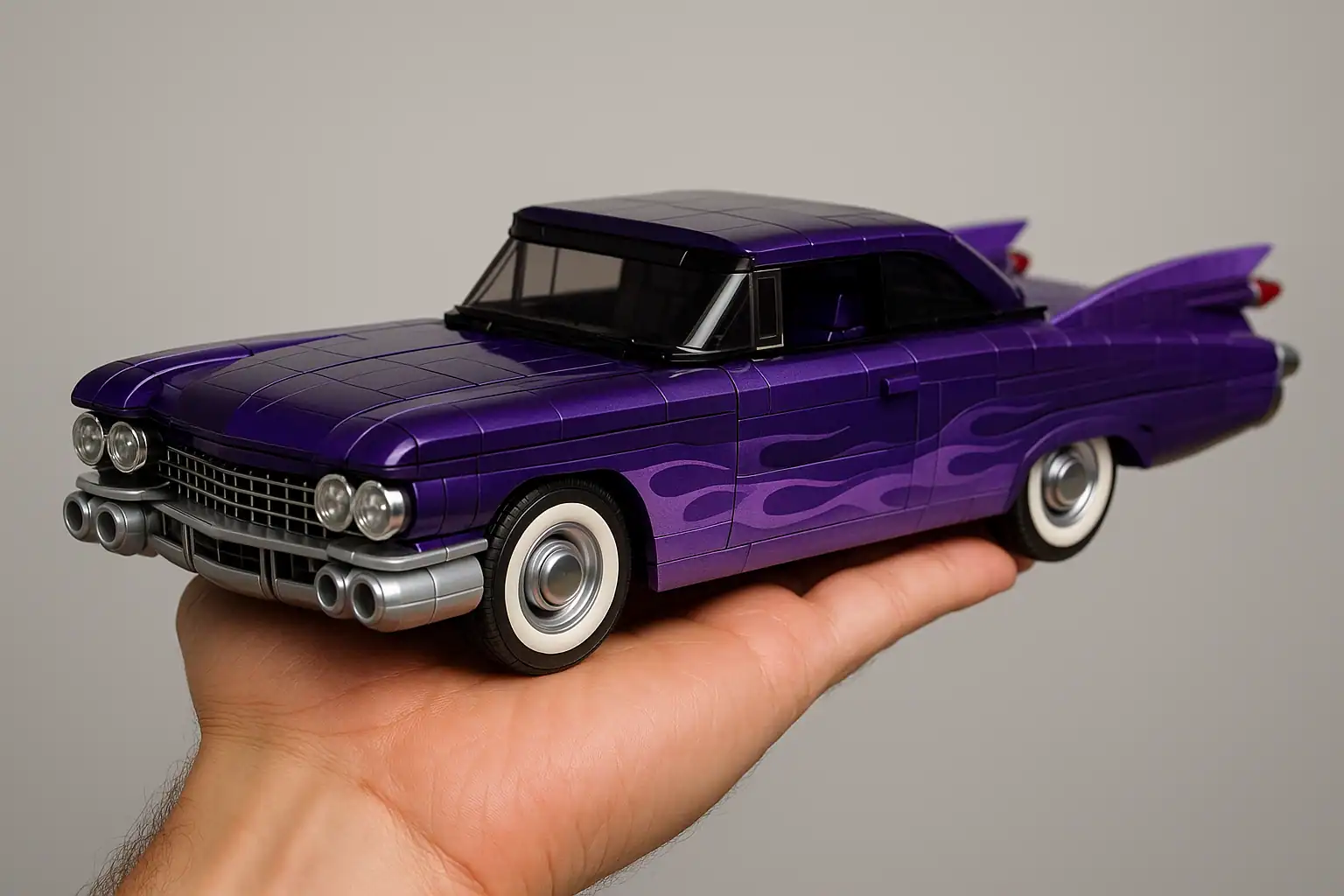
Level 1 — Snapshot
Overview
Set your controls and click Generate Plans to create an at-a-glance
description of your LEGO 1959 Cadillac “Wild Cad” build.

Generator for a museum-grade LEGO block clone of Mario Colalillo’s legendary “Wild Cad” — a radically chopped, airbag-slammed 1959 Cadillac Coupe De Ville with mile-long fins, hand-sculpted metal interior and Gene Winfield’s fade-away purple paint over acres of chrome.
“Wild Cad” began life as a tired 1959 Cadillac Coupe De Ville shell: no front sheet-metal, no interior, the roof cut off and leaning against a fence. Australian builder Mario Colalillo saw it as the perfect blank canvas for a no-limits custom and set out to create an impossibly low, fully metal-worked show car rather than a simple restoration.
The car now rides on a hand-fabricated mono chassis with airbag suspension so it can sit literally on the rockers on the show floor yet rise to driveable height. Bodywork is extensively reshaped: the roof is chopped by about five inches, the body is nosed, decked and shaved, and the fins and rear quarters are smoothed to emphasise the Cadillac’s already exaggerated jet-age lines.
Power comes from a 454 ci Chevrolet big-block V8 backed by a Turbo-Hydramatic 400 automatic transmission, giving show-worthy torque and street-usable reliability. The custom chassis integrates the air-ride hardware and keeps the long, heavy coupe stable at its very low display stance. In LEGO, this translates into a stiff Technic spine tied into both bumpers, with clip-on “aired-up” and “laid-out” ride-height modules instead of real suspension movement.
Wild Cad is famous for its candy purple fade-away paint applied by custom legend Gene Winfield. Several tones of PPG Vibrance purple and magenta are blended from nose to tail, accented by subtle flames along the rockers and huge areas of polished chrome bumpers and trim. Remote-controlled doors, bonnet and boot add theatre at shows, revealing the detailed engine bay and interior at the touch of a button.
For a LEGO clone, the fade is suggested by stepped bands of bright light blue, dark purple, medium lavender and metallic-style light bluish gray, with chrome represented by flat silver, light bluish gray and carefully placed metallic elements. The iconic 1959 bullet taillights and knife-edge fins are key silhouettes to preserve even at smaller scales.
Inside, Wild Cad uses reworked Thunderbird-style seating and a centre-mounted instrument cluster sourced from a 1959 Chevrolet, all integrated into a fully metal-sculpted interior. Even the headliner is metal, formed from another ’59 roof skin. A fin-shaped console runs between the seats and doubles as an interior light feature, while a hidden sound system keeps the cabin clean and futuristic.
In LEGO, the interior should read as seamless and sculpted rather than brick-stacked: smooth tiles and curved slopes, SNOT-mounted panels, and a central spine console in metallic colours. The dashboard can use 1×1 round tiles and printed gauge elements in a central pod, with the steering wheel and column raked to echo the custom driving position.
Wild Cad’s real-world finish uses exotic candy paints, heavy chrome and bespoke metalwork. The LEGO version uses production colours only; where an ideal shade does not exist, plans specify close matches and alternates in common colours (for example, bright light blue or dark purple instead of true candy). Any suggested chrome is rendered with standard light bluish gray, flat silver or drum-lacquered parts to keep the build BrickLink-realistic.
The Level 3 BOM is provided as plain text grouped by chassis, body, interior, glazing, wheels and display base, with approximate quantities for each element type. This makes it easy to paste into a BrickLink list or spreadsheet when organising parts for one or more LEGO Wild Cad replicas.
Disclaimer: Our real-world build plans are designed with the help of AI, and while we aim for accuracy, minor errors or inconsistencies may occur. Part fit, stability, colors, and availability may differ from renders, and some substitutions may be required. Use of any plans, generators, or files is at your own risk. TacoCat in Texas is not liable for issues arising from site use, and is not affiliated with or endorsed by LEGO®. Please verify suitability and safety before building.
The 1959 Cadillac Coupe DeVille represents the peak of 1950s American styling. Its massive tailfins and bold design made it instantly recognizable worldwide.
Because of that, it remains one of the most famous cars ever built.
The Coupe DeVille pushed styling to its extreme. That bold approach helped define an entire era.
As a result, it became legendary.
The 1959 Cadillac Coupe DeVille is bold and unforgettable. It stands as the ultimate symbol of 1950s American design.