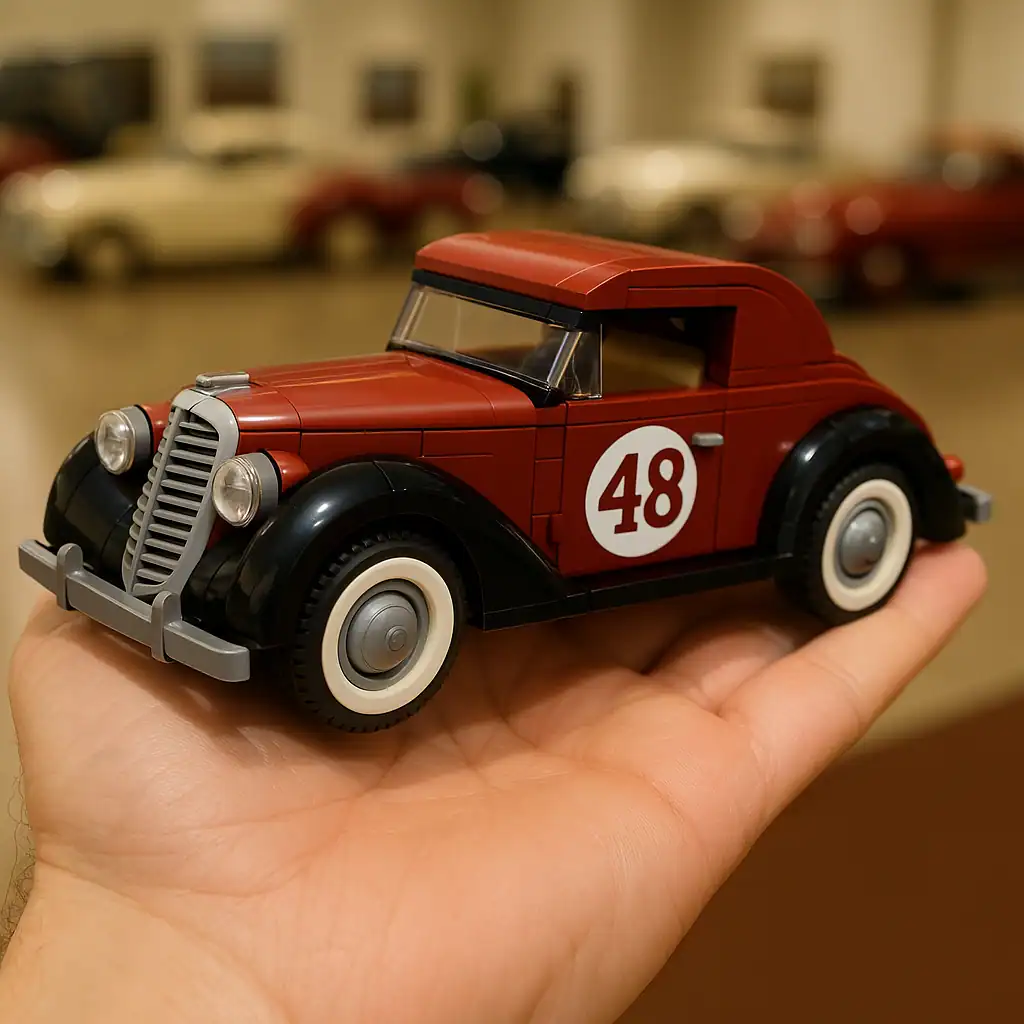
Level 1 — Snapshot
Overview
Set your controls and click Generate Plans to create a quick overview
of your LEGO 1937 Peugeot 402 Eclipse retractable-hardtop build.

Generator for a museum-grade LEGO block clone of the 1937 Peugeot 402 Eclipse — the sleek French streamliner with Georges Paulin’s pioneering retractable steel hardtop, bodied by Carrosserie Pourtout on the long-wheelbase 402 chassis.
Peugeot’s 402 range arrived in 1935 as a streamlined large family car with a raked grille and headlamps hidden behind it. The 402 Eclipse variant, created with coachbuilder Marcel Pourtout and designer Georges Paulin, was among the first production cars to feature a fully retractable steel hardtop that folded into the rear deck — the direct ancestor of modern coupé-cabriolets. Built on the long 402 chassis, the Eclipse offered elegant coupé lines when the roof was raised and full open-air motoring when stowed.
Underneath the flowing bodywork sits Peugeot’s conventional but robust front-engine, rear-wheel-drive chassis with independent front suspension, a live rear axle and hydraulic brakes. Most 402s used a partially synchronized 3-speed gearbox, while some luxury examples were equipped with a four-speed Cotal electromagnetic preselector transmission.
Power came from a 1,991 cc overhead-valve inline-four producing about 55 hp, enough to push the streamlined Eclipse to roughly 120 km/h (75 mph). Later 402B models grew to 2,142 cc and around 60–63 hp, but the 1937 Eclipse sits squarely in the original 2.0-litre era. For your LEGO clone, this means a compact engine bay with a long, low bonnet and modest radiator opening.
The Eclipse’s steel body continues the “fuseau de Sochaux” teardrop theme: faired-in headlamps behind the grille, flowing front wings, integrated rear spats and a long tail to accommodate the folding top. Paulin’s patented mechanism pivots the metal roof backwards and down into the boot; from outside the transformation is clean, with only a discreet joint line along the rear deck. Many cars were finished in sober colours such as deep brown or green with tan interiors and occasionally carried fitted luggage in the trunk, making them ideal grand tourisme machines.
The Eclipse was never a high-volume car. Period sources suggest fewer than 500 examples of the 402 Eclipse were built across all years and wheelbases, making any surviving car highly collectible today. That rarity is part of what your LEGO model can celebrate: a quiet French engineering revolution that prefigured post-war hardtop convertibles.
Disclaimer: Our real-world build plans are designed with the help of AI, and while we aim for accuracy, minor errors or inconsistencies may occur. Part fit, stability, colors, and availability may differ from renders, and some substitutions may be required. Use of any plans, generators, or files is at your own risk. TacoCat in Texas is not liable for issues arising from site use, and is not affiliated with or endorsed by LEGO®. Please verify suitability and safety before building.
The 1937 Peugeot 402 Eclipse stands out as one of the most innovative classics of its era. It blended sleek French styling with a roof concept that still feels modern today.
Because of that, it remains one of the most fascinating pre-war design achievements.
Most convertibles of the time used simple folding tops. The Eclipse offered a more advanced retractable hardtop idea that made it feel far ahead of its time.
The 402 Eclipse was not only clever. It also looked graceful and modern, which helped it stand out among other 1930s cars.
As a result, it became one of the most memorable Peugeot classics ever built.
The 1937 Peugeot 402 Eclipse matters because it helped preview features later seen on much newer cars. It remains a landmark of early automotive imagination and engineering.
The 1937 Peugeot 402 Eclipse is elegant, inventive, and historically important. It stands as one of the great ahead-of-its-time classics in car history.