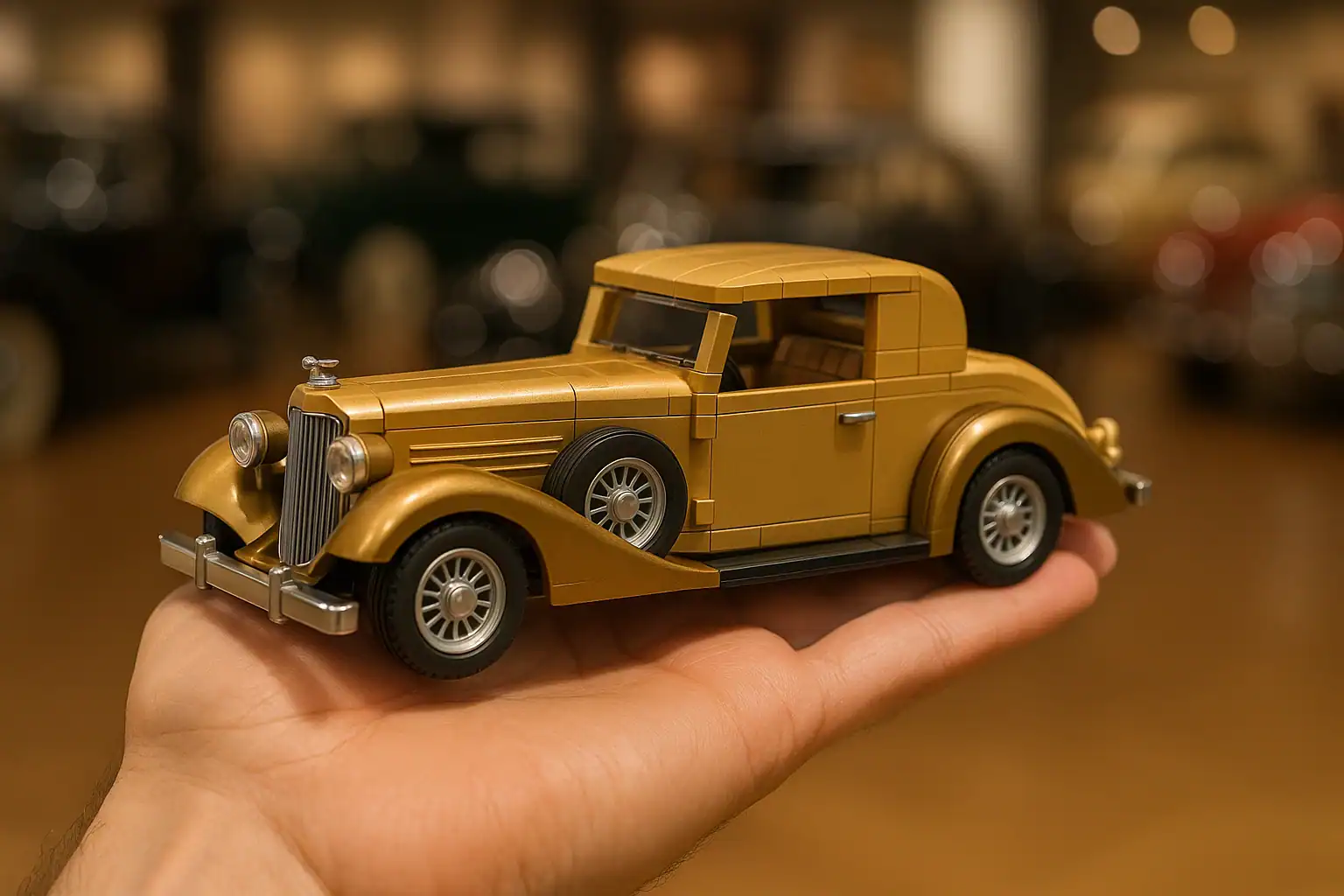
Level 1 — Snapshot
Overview
Set your controls and click Generate Plans to get a quick overview
of your LEGO 1936 Stout Scarab — the streamlined “office on wheels” many
consider the world’s first minivan.

Generator for a museum-grade LEGO clone of the 1936 Stout Scarab — William B. Stout’s rear-engined, spaceframe “office on wheels” often cited as the world’s first production minivan, hand-built in single-digits and packed with aviation-inspired engineering.:contentReference[oaicite:0]{index=0}
The Stout Scarab was designed by aviation engineer William Bushnell Stout and styled by John Tjaarda. Conceived as a “travelling office”, it used aircraft thinking: an early spaceframe/monocoque body and a rear-mounted powertrain to free up a low, flat floor. Many historians regard it as the world’s first production minivan thanks to its one-box profile, lounge-like cabin and reconfigurable seating.:contentReference[oaicite:8]{index=8}
The 1932 prototype used an aluminum spaceframe body — probably the first car to do so — but production Scarabs switched to steel to reduce cost while keeping the teardrop fuselage shape. Later, the 1946 Scarab Experimental became the world’s first fiberglass-bodied monocoque car, again with the engine at the rear.:contentReference[oaicite:9]{index=9}
The long 135 in wheelbase and ponton sides eliminated running boards, stretching the cabin to the full width of the car. Chrome bars over the rear window and fine front grilles gave the Scarab its distinctive Art Deco look, echoed by scarab-motif emblems and vents.:contentReference[oaicite:10]{index=10}
Stout used many Ford components, notably an 85 hp 221 cu in Ford flathead V8 mounted backwards over the rear axle, driving through a custom three-speed transaxle. Weight distribution was roughly one-third front, two-thirds rear, helping traction. All four wheels rode on independent coil-spring suspension, unusual for the mid-1930s and inspired by aircraft landing gear.:contentReference[oaicite:11]{index=11}
The Scarab’s interior was radically different from a typical sedan. Only the driver’s seat was fixed; other seats could slide, swivel or be removed entirely, and a central table folded out so passengers could face one another. This flexible lounge layout, combined with large windows and a flat floor, anticipates modern MPVs such as the Chrysler Voyager and Renault Espace by about fifty years.:contentReference[oaicite:12]{index=12}
Stout hoped to build up to 100 Scarabs a year and priced them around $5,000 — several times the cost of a contemporary Chrysler Imperial Airflow — but hand construction and the radical design limited sales. Most sources agree that only about nine Scarabs were completed, many going to Stout board members and industrialists such as Harvey Firestone and Philip Wrigley. Today only a handful survive, making the car one of the rarest American designs of the 1930s.:contentReference[oaicite:13]{index=13}
Disclaimer: Our real-world build plans are designed with the help of AI, and while we aim for accuracy, minor errors or inconsistencies may occur. Part fit, stability, colors, and availability may differ from renders, and some substitutions may be required. Use of any plans, generators, or files is at your own risk. TacoCat in Texas is not liable for issues arising from site use, and is not affiliated with or endorsed by LEGO®. Please verify suitability and safety before building.
The 1936 Stout Scarab is one of the most unusual and forward-looking vehicles of the pre-war era. Its shape, layout, and concept made it feel decades ahead of its time.
Because of that, it remains a favorite among readers who love visionary design.
Most 1930s cars followed familiar long-hood styling. The Scarab broke away with a more spacious and advanced design idea.
The Scarab suggested that cars could be built around interior space and versatility, not just appearance. That made it one of the most inventive vehicles of its time.
As a result, it still feels fresh to modern readers.
The 1936 Stout Scarab matters because it anticipated ideas later seen in vans, MPVs, and design-driven concept vehicles. It remains a landmark of automotive imagination.
The 1936 Stout Scarab is bold, rare, and unforgettable. It stands as one of the great futuristic classics in automotive history.