
Page hero image

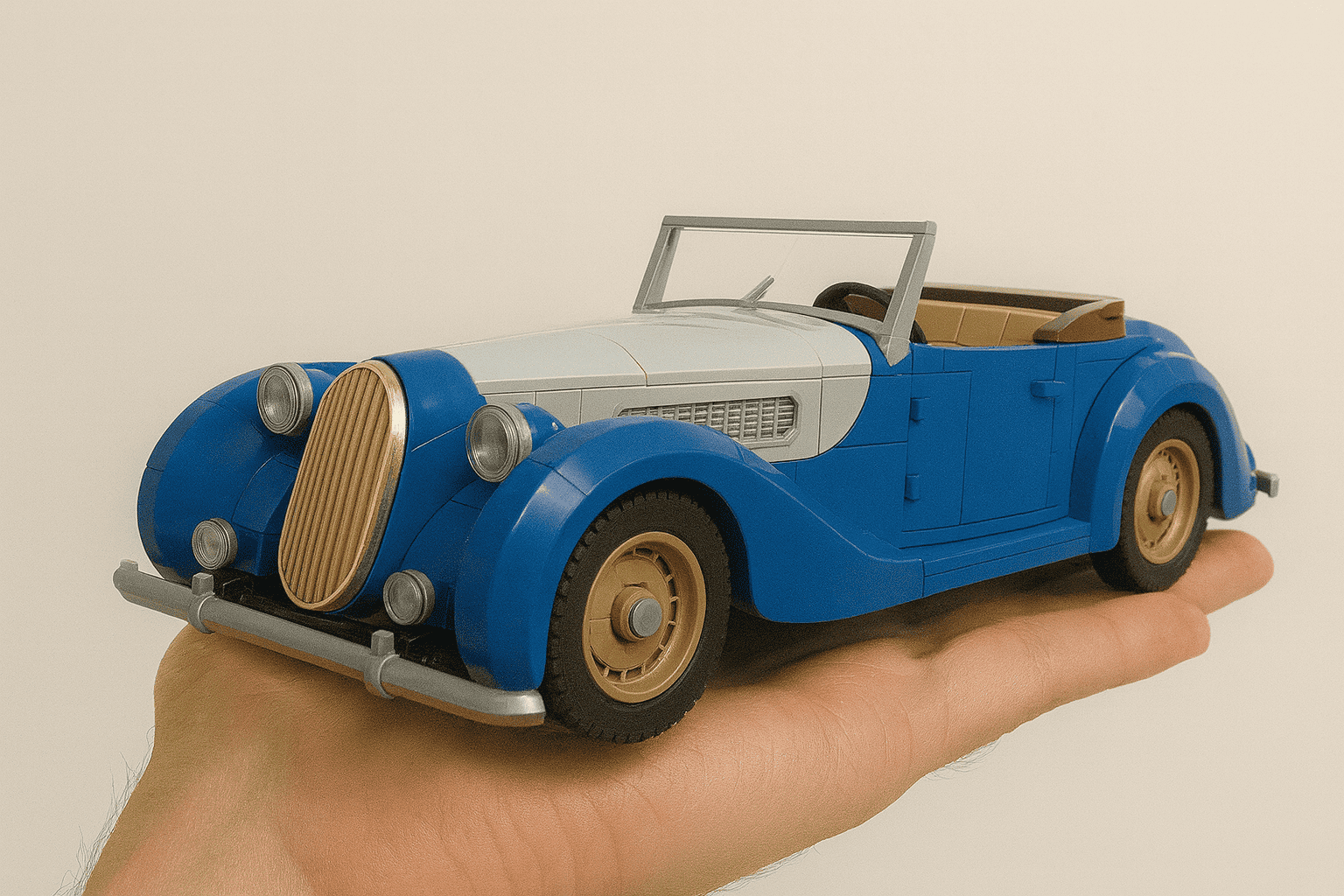
View the Built LEGO Model Image for This Vintage Car

1936 Bugatti Type 50T Cabriolet — LEGO1 Simplex Real‑Build Mode ON

Generate buildable plans & prompts for a faithful, brick‑ready museum clone of a Jean‑era Bugatti touring cabriolet.

How to use these results

Real‑Build Mode: Favor BrickLink‑available parts & legal connections. Signatures to capture: oval Bugatti grille and badge, teardrop fenders, long louvered hood/cowl vents, twin external horns, slim chrome bumpers, and the elegant split rear deck. Use SNOT tiles for stone‑guard/grille texture; rigid ladder spine with Technic cross‑members for the long wheelbase. No fantasy pieces.

Level 1 — Snapshot


Level 2 — Builder Brief


Level 3 — Detailed Prompt (Parts & Techniques)


Level 4 — Press‑Release (Museum Label)


Research Dossier — Bugatti Type 50T (1936)

Chassis
Long‑wheelbase 50T touring frame (~3500 mm), steel ladder with live axles; cable‑operated drum brakes; 3‑speed in unit with rear axle.
Engine
4.9‑litre DOHC straight‑eight, Roots‑supercharged (bore×stroke 86×107 mm); approx. 200–225 hp @ 4000 rpm.
Coachwork
Cabriolets by Bugatti/Million‑Guiet and others; oval grille, faired lamps, long side louvers, split rear deck, low screen.
Wheels/Tyres
Alloy dish/steel cap or wire‑effect; period tyre OD ~710–730 mm (choose LEGO tyre per scale).

Use the menus to match your target car’s colors, top state, lamp package, wheel style, and rear‑deck treatment. Click Generate to bake choices into all four outputs. Prompts prioritize robust, legal LEGO techniques with readily available parts.

History — Bugatti Type 50 & 50T

The Type 50 was Bugatti’s grand touring flagship of the early 1930s. It introduced a powerful 4.9‑litre DOHC straight‑eight derived from Bugatti’s GP experience and paired it with refined coachwork by Bugatti and top French carrosseries. The long‑wheelbase Type 50T (“Touring”) was the more commodious derivative favored for elegant cabriolets like the example modeled here.

Production numbers for the Type 50 family were limited (a few dozen in total), and each chassis was typically finished by a coachbuilder—hence the variety in fender lines, screen height, and deck treatments. Period cars often wore two‑tone blue schemes, the oval Bugatti grille, teardrop fenders, and delicately curved bumpers. Racing outings occurred with the short‑wheelbase cars, but the 50T’s mission was fast, luxurious travel.

Disclaimer: Our real-world build plans are designed with the help of AI, and while we aim for accuracy, minor errors or inconsistencies may occur. Part fit, stability, colors, and availability may differ from renders, and some substitutions may be required. Use of any plans, generators, or files is at your own risk. TacoCat in Texas is not liable for issues arising from site use, and is not affiliated with or endorsed by LEGO®. Please verify suitability and safety before building.

1936 Bugatti Cabriolet: Open-Air French Luxury with Timeless Elegance

1936 Bugatti Cabriolet: Open-Air French Luxury with Timeless Elegance

The 1936 Bugatti Cabriolet adds open-air grace to one of the most prestigious names in classic motoring. It blends elegance, exclusivity, and the strong identity Bugatti is famous for.

Because of that, it remains a compelling subject for readers who love refined European classics.

Why the Bugatti Cabriolet Stands Out

A cabriolet body gives a luxury car more freedom and visual lightness. In Bugatti form, that layout becomes even more distinctive.

Style That Feels Effortless

Bugatti models often feel artistic as much as mechanical. The cabriolet body makes that impression even stronger by emphasizing shape and proportion.

As a result, it remains visually memorable.

Why It Still Matters Today

The 1936 Bugatti Cabriolet matters because it shows the softer, more elegant side of Bugatti heritage. It adds luxury and grace to a brand often linked with performance legend.

Final Thoughts

The 1936 Bugatti Cabriolet is elegant, prestigious, and timeless. It remains a beautiful expression of French automotive refinement.


Explore More

Like This Free Tool?

Help TacoCat keep building useful generators, guides, and creative tools for everyone.

Send a Small Tip