Level 1 — Snapshot
Overview
Set your controls and click Generate Plans to create an at-a-glance
description of your LEGO 1935 Blue Bird land speed record model.

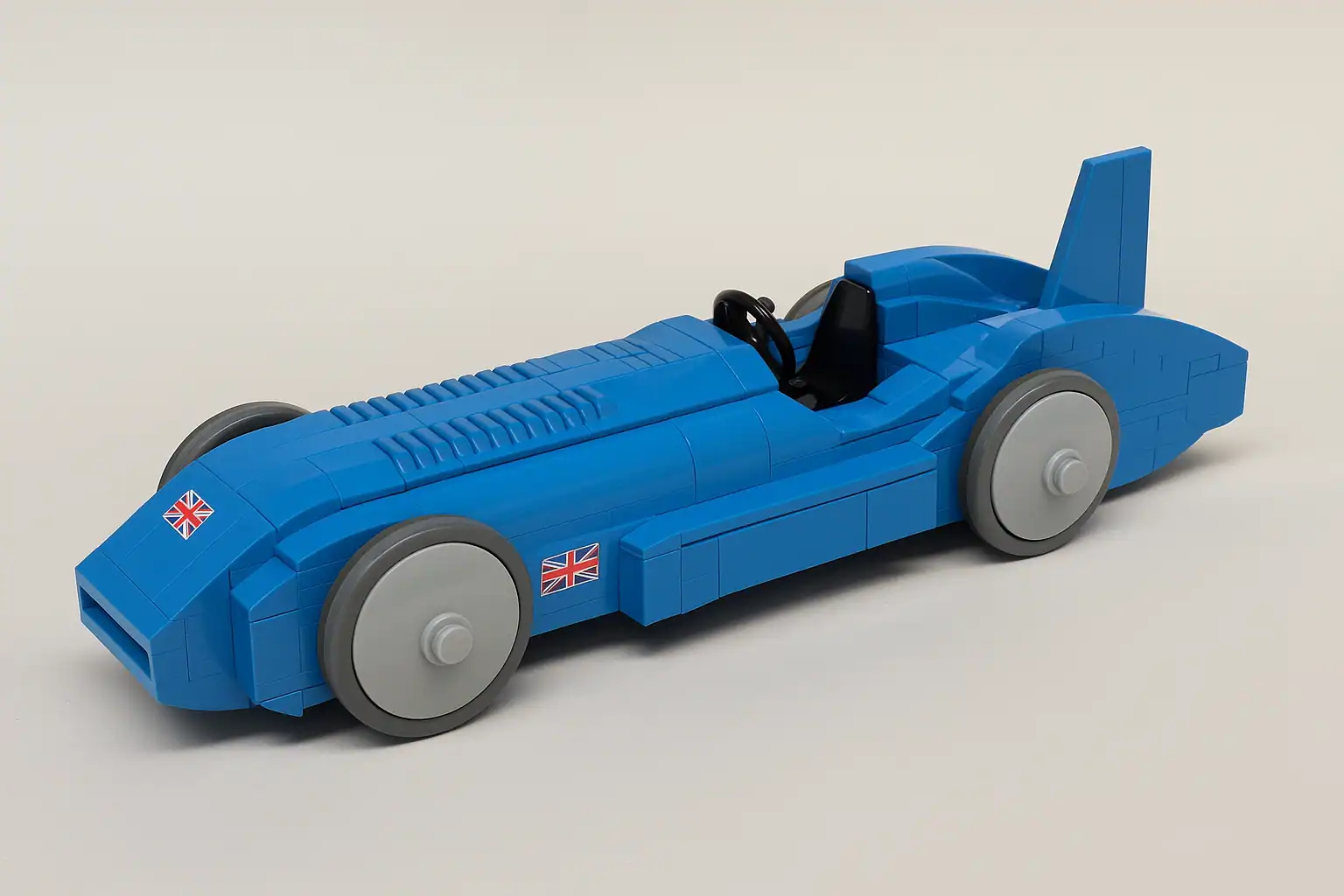
Generator for a museum-grade LEGO block clone of the 1935 Campbell–Railton Blue Bird — the sleek, Rolls-Royce R-powered land speed record car that finally pushed Sir Malcolm Campbell past the 300 mph barrier on the salt at Bonneville.
The 1935 Blue Bird started life as the earlier Campbell-Napier-Railton car, but by the time it reached Bonneville it had been extensively rebuilt around a supercharged Rolls-Royce R aero engine. The 36.7-litre V12 produced well over 2,300 hp, driving through a strengthened transmission into the rear axle, which now carried twin wheels on each side to claw for grip on sand and salt.
Blue Bird’s wheelbase stretched to about 4.2 m with an overall length of roughly 8.2 m, yet the car sat extremely low thanks to deep side rails and compact suspension. By 1935 the bodywork had become a full-width, almost rectangular shell over the wheels, visually lower than it really was and capped by a tall tailfin to keep the car tracking straight at over 300 mph.
The revised body was tested in the wind tunnel before being built in aluminium by Gurney Nutting. Long ridges over the engine camboxes, a flush nose and almost enclosed wheels reduced drag, while airbrake flaps at the rear and a closable radiator slot gave Campbell brief bursts of maximum speed on the measured mile.
After further work on traction following difficult runs on Daytona Beach, Campbell moved Blue Bird to the smoother Bonneville Salt Flats. On 3 September 1935 he averaged just over 301 mph for the flying mile, becoming the first person to officially exceed 300 mph on land and closing out his land-speed career in this car.
Disclaimer: Our real-world build plans are designed with the help of AI, and while we aim for accuracy, minor errors or inconsistencies may occur. Part fit, stability, colors, and availability may differ from renders, and some substitutions may be required. Use of any plans, generators, or files is at your own risk. TacoCat in Texas is not liable for issues arising from site use, and is not affiliated with or endorsed by LEGO®. Please verify suitability and safety before building.
The 1935 Blue Bird carries a name closely linked with speed and ambition. It represents the dramatic pursuit of performance during one of the most exciting eras in motoring history.
Because of that, it remains a compelling topic for readers who enjoy record-focused machines.
Few names in vintage motoring suggest speed as strongly as Blue Bird. It brings to mind bold engineering, daring effort, and the pursuit of new limits.
Vehicles associated with record attempts often looked and felt different from normal cars. They were shaped by the need to go faster and further than before.
As a result, they remain some of the most fascinating machines in automotive history.
The 1935 Blue Bird matters because it captures the spirit of pure speed ambition. It shows how much excitement and innovation surrounded performance in the 1930s.
The 1935 Blue Bird remains dramatic, memorable, and historically rich. It is a standout subject for anyone interested in vintage speed culture.
Your support helps fund hosting, updates, and new creative tools for builders, writers, and makers.
Support Free Tools