Level 1 — Snapshot
Overview
Set your controls and click Generate Plans to get a quick overview
of your LEGO 1930 Austin Seven saloon — the classic “Baby Austin” town car.

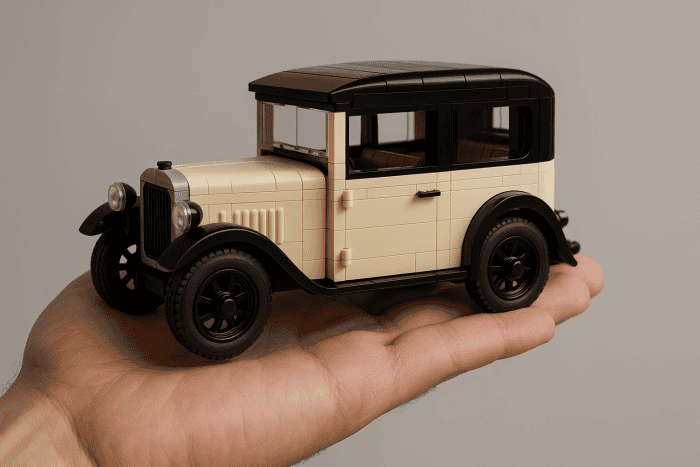
Generator for a museum-grade LEGO clone of the 1930 Austin Seven saloon — the tiny “Baby Austin” economy car with 747 cc side-valve four, 75 in (1.9 m) wheelbase and featherweight 360–375 kg kerb mass that motorised Britain and much of the world.:contentReference[oaicite:0]{index=0}
The Austin Seven, launched in 1922, was Britain’s first true “people’s car”. With a compact four-cylinder engine and a very small chassis, it allowed working and lower middle-class families to own a practical car for the first time. Its impact on the UK market mirrored the Ford Model T in the United States, wiping out many cyclecars and small makers and becoming a standard sight on British streets.:contentReference[oaicite:1]{index=1}
Early Sevens used a 696 cc engine, but from 1923 the capacity grew to 747 cc, giving around 10–12 hp — just enough to move the lightweight 360–375 kg saloon at about 45 mph. The engine sits in an “A”-shaped ladder chassis with beam axles, quarter-elliptic rear springs and brakes on all four wheels, fully coupled by 1930.:contentReference[oaicite:2]{index=2}
By 1930, steel-panelled saloons such as the RL and fabric-bodied RG had joined the tourers, vans and sports models already on offer. The saloon’s boxy two-door body with high roofline and narrow track made it compact yet surprisingly roomy for four small adults, and it quickly became the most popular Seven body style for everyday use.:contentReference[oaicite:3]{index=3}
The Austin Seven saloon is tiny even by pre-war standards: a wheelbase of only 75 in (1.9 m), overall length 110 in (2.8 m) and width just 46 in (1.2 m). This gives it a tall, narrow stance with very short overhangs, cycle wings and 19 inch wire wheels filling the arches. These proportions are essential to capture in a LEGO model so that it reads instantly as a Seven rather than a generic 1930s saloon.:contentReference[oaicite:4]{index=4}
The Seven’s design was licensed or copied around the world: BMW’s first car (the Dixi 3/15), the American Austin and Bantam, Rosengart in France and early Datsun in Japan all owed their basic layout to the Austin Seven. That worldwide reach means your LEGO build can plausibly wear British, European or overseas plates and colours, while still remaining historically grounded.:contentReference[oaicite:5]{index=5}
Disclaimer: Our real-world build plans are designed with the help of AI, and while we aim for accuracy, minor errors or inconsistencies may occur. Part fit, stability, colors, and availability may differ from renders, and some substitutions may be required. Use of any plans, generators, or files is at your own risk. TacoCat in Texas is not liable for issues arising from site use, and is not affiliated with or endorsed by LEGO®. Please verify suitability and safety before building.
The 1930 Austin Seven Saloon is one of the great small cars of early motoring. It offered practical transport in a compact and approachable package.
Because of that, it became deeply important in automotive history.
Not every great classic was large or expensive. The Austin Seven mattered because it helped make motoring more accessible to ordinary buyers.
The Austin Seven focused on usefulness and affordability. It gave drivers a simpler way to enjoy the freedom of the road.
As a result, it became one of the era’s most meaningful small cars.
The 1930 Austin Seven Saloon remains popular because it represents accessible classic motoring. It helped prove that small cars could shape the future just as much as luxury models.
The 1930 Austin Seven Saloon is a compact classic with major historical weight. It remains one of the most important small cars of its era.