Level 1 — Snapshot
Overview
Set your controls and click Generate Plans to create an at-a-glance
description of your LEGO 1928 Bugatti Type 35B build.

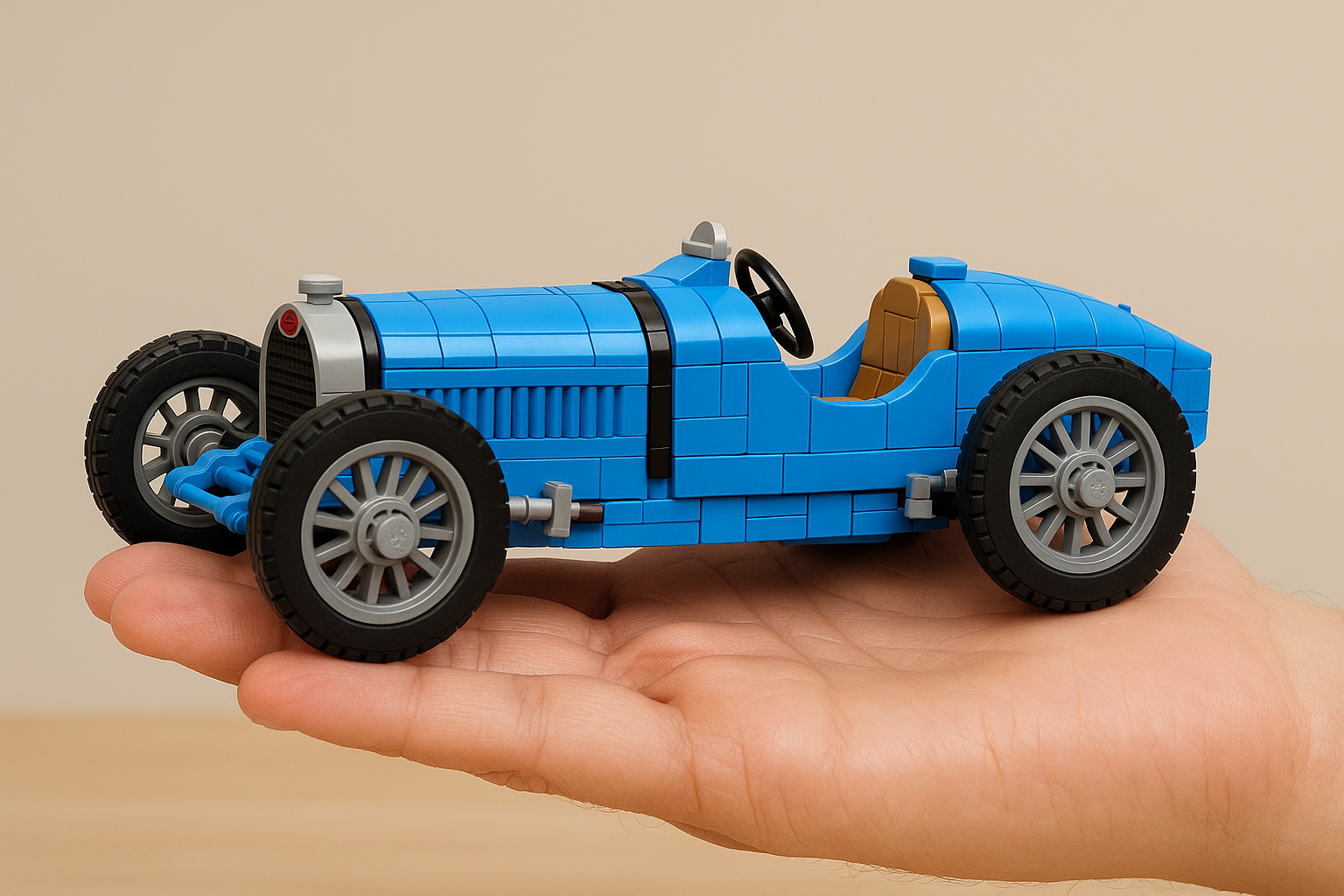
Generator for a museum-grade LEGO block clone of the 1928 Bugatti Type 35B — the ultimate supercharged evolution of Bugatti’s legendary Grand Prix car, with its 2.3 L straight-eight, cast alloy wheels and hollow front axle that helped the Type 35 family score over a thousand race victories and the 1926 Grand Prix World Championship. :contentReference[oaicite:0]{index=0}
The Bugatti Type 35 family debuted in 1924 and quickly became the dominant Grand Prix car of its era, with the design winning the 1926 Grand Prix World Championship and taking numerous victories in the Targa Florio and other major events. In its later, more powerful 2.3-litre supercharged form — the Type 35B or factory “Type 35TC” — output rose to around 130–140 hp and top speed exceeded 215 km/h (≈130 mph), remarkable figures for a machine weighing roughly 750 kg. :contentReference[oaicite:10]{index=10}
Under the long, tapered bonnet sits a jewel-like straight-eight with an aluminium block and head, three valves per cylinder and a Roots-type supercharger, feeding a four-speed manual gearbox that drives a live rear axle. The chassis is a ladder frame with live axles front and rear on semi-elliptic leaf springs, tuned for exceptional grip and neutrality on pre-war road circuits. :contentReference[oaicite:11]{index=11}
Ettore Bugatti chased low unsprung mass and precision steering. The Type 35 pioneered cast aluminium wheels with integral brake drums and used a hollow forged front axle with sealed ends, weighing only around ten kilograms. These measures gave the car superior braking, cooling and grip over rough, fast road circuits, all while keeping the complete car’s weight near three-quarters of a ton. :contentReference[oaicite:12]{index=12}
Across its various forms, the Type 35 is credited with more than a thousand race wins, averaging roughly a dozen victories a month at its height. Between 1925 and 1929 it dominated the demanding Targa Florio road race, taking five consecutive victories, and in Type 35B trim won major events including the inaugural Monaco Grand Prix in 1929 with William Grover-Williams and multiple Targa Florio outings with Albert Divo. :contentReference[oaicite:13]{index=13}
The Type 35 cockpit is minimalist but finely crafted: a tight two-seat tub with leather buckets, high transmission tunnel, a four-spoke steering wheel and a turned aluminium dashboard whose engine-turned finish both beautified the surface and helped prevent stress cracking. Large analog instruments, exposed control linkages and a floor shifter complete the picture, creating a purposeful but jewel-like environment. :contentReference[oaicite:14]{index=14}
For LEGO, this translates into a single- or tight two-seat cockpit with tan or dark tan seats, a stud-down “engine-turned” dash using patterned tiles, a small instrument cluster and a prominent steering wheel offset slightly rearwards relative to the front axle line.
Where early Bugatti alloy wheel geometry or narrow cross-ply tyres can’t be matched exactly, the plans specify modern LEGO wheel/tyre combinations that keep overall diameter and slender proportions close, along with suggested substitutes in common colors such as light bluish gray, flat silver and black. Any chrome or polished aluminium on the real car is rendered with these standard LEGO finishes to remain BrickLink-realistic.
The Level 3 text-only BOM is grouped by chassis, body, cockpit and running gear with approximate quantities and element references, making it easy to paste into a BrickLink note or a simple spreadsheet when you or a museum team assemble parts for one or more Type 35B builds.
The 1928 Bugatti Type 35B took an already famous race car and pushed it further. It added more performance and became one of the most exciting versions of the Type 35 family.
Because of that, it remains highly admired by racing historians and collectors.
The Type 35B was an advanced evolution of the original Type 35. It offered stronger performance and sharper race-ready character.
Bugatti created this version for drivers who wanted even more from the Type 35 platform. It delivered greater power without losing the elegance the brand was known for.
As a result, it became one of the standout pre-war competition cars.
Like other Bugatti racers, the Type 35B looked refined and purposeful. That mix of beauty and competition spirit still makes it special today.
The Type 35B shows how Bugatti refined a winning formula. It highlights the brand’s ability to blend engineering, speed, and style into one memorable machine.
The 1928 Bugatti Type 35B remains a major part of vintage racing history. It is a thrilling example of pre-war performance done right.
Disclaimer: Our real-world build plans are designed with the help of AI, and while we aim for accuracy, minor errors or inconsistencies may occur. Part fit, stability, colors, and availability may differ from renders, and some substitutions may be required. Use of any plans, generators, or files is at your own risk. TacoCat in Texas is not liable for issues arising from site use, and is not affiliated with or endorsed by LEGO®. Please verify suitability and safety before building.
These free online tools help visitors create build packs, prompts, guides, and creative projects. A small PayPal tip helps keep them updated and available.
Support the Project