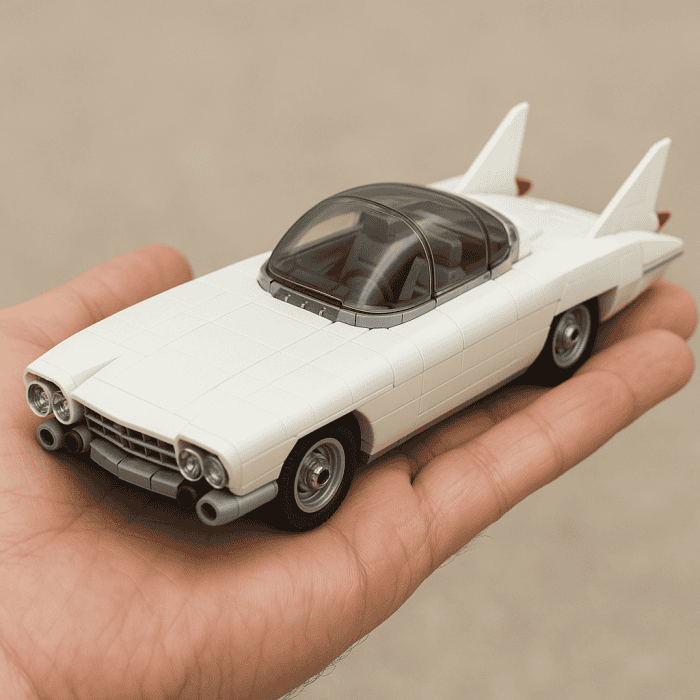
LEGO1 banner artwork for 1959 Cadillac Cyclone XP-74 model
View the Built LEGO Model Image for This Vintage Car

1959 Cadillac Cyclone XP-74 — LEGO1 Simplex Car Plans

Real-Build Mode • BrickLink Legal

Generator for a museum-grade LEGO block clone of the 1959 Cadillac Cyclone XP-74 concept — Harley Earl’s jet-age “laboratory on wheels” with radar nose cones, sliding doors and a clear bubble canopy over a shortened Cadillac chassis.

EngineCast-iron 389 C.I. V8 • ~350 hp ChassisShortened 104" wheelbase • all-independent suspension TechRadar crash-avoidance • bubble canopy • sliding doors RoleExperimental XP-74 concept, 1959

Final Prompts (Levels 1–4)

Level 1 — Snapshot

Overview
Set your controls and click Generate Plans to create an at-a-glance description of your LEGO 1959 Cadillac Cyclone XP-74 concept model.

Level 2 — Builder Brief

For human builders
The Builder Brief will explain proportions, stance, major sub-assemblies and how to translate the needle nose cones, bubble canopy, sliding doors and twin fins into LEGO.

Level 3 — Detailed Prompt

Parts & techniques
Here you’ll get the brick-legal specification: Technic spine and subframes, body sculpting for the cigar shape, radar cone construction, canopy mechanism ideas and a text-only BOM grouped by chassis, body, cockpit and experimental hardware.

Level 4 — Press-Release

Museum label
The Press-Release turns your finished LEGO Cyclone into exhibit text: how XP-74 previewed radar safety systems and automated driving decades before they reached production.
Jet-age bubble canopy & twin fins Radar cones & proximity sensing Short 104" wheelbase concept chassis

Research Dossier — 1959 Cadillac Cyclone XP-74

Jet-Age Dream Car & XP-74 Program

The Cyclone XP-74 was one of Harley Earl’s last dream cars and a rolling testbed for futuristic styling and technology. Built on a Cadillac chassis shortened to about 104 inches, it swapped normal bodywork for a cigar-shaped fuselage with nose cones, twin fins and a two-seat cockpit under a clear bubble canopy.

V8 Power & Experimental Chassis

Beneath the long front deck sits a cast-iron 389/390 cubic inch V8, making roughly 325–350 horsepower and driving the rear wheels through a three-speed transmission. Independent suspension and air-spring hardware were used to keep the car low while preserving ride quality, and the exhaust exited just ahead of the front wheels to free space for a flat floor and short tail.

Radar Nose Cones & Sliding Doors

The most dramatic details are the black-tipped nose cones, which housed a radar-based crash-avoidance system meant to warn the driver of hazards ahead. The clear canopy was silver-coated for UV protection and could raise automatically, while the doors slid backwards on ball bearings instead of swinging out, giving the Cyclone a spacecraft feel during GM’s Motorama-style shows.

From 1959 Debut to Later Updates

Early show photos show tall fins and white paint with silver canopy tint. Later, under Bill Mitchell, the fins were trimmed, the suspension simplified and the car repainted silver, closer to how it appears in the GM Heritage Collection today. Your LEGO model can represent either version or a curated museum hybrid.

Modeling Priorities for a LEGO Clone

  • Maintain the extremely short wheelbase and long overhangs so the model reads as a compact jet fuselage on wheels.
  • Use brackets and tiles to keep the upper body nearly featureless, with strong panel lines only where doors and canopy meet the shell.
  • Build the nose cones as separate modules that can be removed to show radar hardware or left smooth for display.
  • Anchor a Technic spine through the floor so the model can be lifted from the middle despite the long, thin bodywork.
  • Reserve trans-clear and metallic elements for canopy, radar lenses and tail “jet exhausts” so the car reads like aerospace hardware.
Real-world building disclaimer: The original Cyclone uses specialised plexiglass, air suspension hardware and custom radar units that LEGO cannot reproduce exactly. This generator sticks to legal LEGO connections and widely available parts; where an ideal color or piece is missing, the prompts include substitution notes so the LEGO Cyclone still reads clearly as XP-74.
Cyclone XP-74 Simplex • Ready

Disclaimer: Our real-world build plans are designed with the help of AI, and while we aim for accuracy, minor errors or inconsistencies may occur. Part fit, stability, colors, and availability may differ from renders, and some substitutions may be required. Use of any plans, generators, or files is at your own risk. TacoCat in Texas is not liable for issues arising from site use, and is not affiliated with or endorsed by LEGO®. Please verify suitability and safety before building.